In 2026, members of the South Asian Coalition engaged in various events, documentation and archival efforts, advocacy campaigns, and narrative strategy to remember and reckon with the impact of the 9/11 attacks and the War on Terror on communities, systems, and policies. Here are 7 of those takeaways.
1. The long-term human consequences of the attacks on September 11, 2001, are still being uncovered and understood, from physical and mental health effects to impacts of Islamophobia to the way in which War on Terror policies are being applied today. This year, the 9/11 memorial ceremony added a seventh bell to honor those who have suffered health effects as a result of the attacks. In September 2026, New York City released 170,000 pages of documentation reflecting that public officials misled residents about toxic air quality levels after 9/11. New conditions and diseases rooted in being in proximity to the rubble at the World Trade Center are still being discovered. For the first time in 2026, a seventh bell was rung during the 9/11 Memorial Ceremony at Ground Zero – to honor those who died from exposure to the toxic ash and rubble at the World Trade Center. In addition to lifelong physical health consequences, many in BAMEMSA and SWANA communities still face an enduring double trauma of experiencing both 9/11 and the backlash that followed, a trauma that is only compounded by the current wave of anti-Muslim and xenophobic public sentiment. Nine community organizations based in New York, including SAC member groups Chhaya CDC, Adhikaar, The Sikh Coalition, Hindus for Human Rights, Sakhi for South Asian Survivors, and Desis Rising Up and Moving (DRUM), co-hosted a vigil to honor those lost on 9/11 and mark 25 years of organizing and civic engagement in the face of the 9/11 backlash and the War on Terror.
2. Current federal policies around national security and immigration are rooted in Islamophobia, profiling, and restrictions on civil liberties that emerged in the days and months after 9/11. 25 years later, the policies that targeted BAMEMSA and SWANA communities after 9/11 have been expanded to target immigrants, transgender people, political dissenters and activists, Black and Brown communities, and community organizations across the country. From the inhumane and widespread mass deportation policies to profiling of immigrants and a return to immigrant registration to the condition of immigration detention centers to the return to Guantánamo Bay for immigrant detention to calling Venezuelan immigrants “alien enemies” to the burgeoning surveillance state to labeling left-leaning actors as terrorists, the current federal administration is actively utilizing tools from the War on Terror to target vulnerable communities across the country. Just as the policies after 9/11 were rooted in centuries of surveillance, discrimination, and policing of Black communities, today’s policies are rooted in the War on Terror apparatus that came after 9/11. SAC members and ecosystem partners have long been informing the public of the impact of post-9/11 policies through consequential reports and analysis, some of which are included below. Find additional learning resources in the 25 Years Later Learning Library.
- Stop the Disappearances: Organizing for Freedom in the Wake of Post-9/11 Violence (2000-2009) (Desis Rising Up and Moving)
- Mapping Muslims: NYPD Spying and its Impact on American Muslims (CLEAR Project, AALDEF and the Muslim American Civil Liberties Coalition)
- Fact Sheet on Post-9/11 Discrimination and Violence against Sikh Americans (The Sikh Coalition)
- Video: “LAPD Muslims Mapping Project” (Shakeel Syed, Islamic Shura Council of Southern California, Islamic Institute of Orange County)
- “Let’s Just Round Them Up”: The Rise of Islamophobia in the Post-9/11 Domestic War on Terror (Democracy Now! interview with Fahd Ahmed, Executive Director of Desis Rising Up and Moving, and Rozina Ali, journalist and author)
- Statement: 25 Years After 9/11, the U.S. Government Is Continuing to Use “Counterterrorism” to Expand Executive Power and Crush Dissent (Center for Constitutional Rights)
- 25 Years of Solidarity (ASATA)
3. Hate against BAMEMSA and SWANA communities remains virulent and has permeated across many mainstream narratives. In a September 2026 report by Stop AAPI Hate found that anti-South Asian slurs rose by 109% between January 2023 and December 2025 and that 48% of South Asian adults said they experienced a hate act due to their race, ethnicity, or nationality in 2025. Many South Asian adults (61%) were also targeted for other aspects of their identity in addition to their race, ethnicity, or nationality in hate acts. The top additional identities targeted were religion (29%), immigration status (23%), and class (23%). 71% of all anti-Asian threats of violence between August 2024 and December 2025 were directed at South Asians, making them the most frequently threatened Asian regional group in online spaces associated with targeted violence. According to Stop AAPI Hate, use of anti-South Asian slurs rose by 109% between January 2023 and December 2025.
According to Pew Research, as of September 2026, “By some measures, public attitudes toward Islam have become more negative than they were immediately after the 9/11 attacks.” The Institute for Social Policy and Understanding’s (ISPU) Islamophobia Index rose from 25 to 33 between 2022 and 2025, the sharpest increase recorded in the Index’s history; and, as of 2025, Muslims continue to report the highest rate of religious discrimination of any faith group ISPU measures (63%), a figure held since 2016.
An analysis by the Sikh Coalition of FBI hate crime data from 2025 found that hate crimes against Sikhs saw an overall increase of 25% from the prior year. Following a September 2026 attack on a Sikh truck driver, the Global Project against Hate and Extremism (GPAHE) found that anti-Sikh and anti-South Asian rhetoric on fringe platforms surged, with mentions of slurs growing by 66 percent over a 4 day period.
These rising trends in hate against Arab, Muslim, Sikh, and South Asian communities have been inflamed by political figures using xenophobic and Islamophobic rhetoric. Research from the Center for the Study of Organized Hate indicates that efforts to malign Muslim Americans – growingly frequent in light of increased Muslim political representation – are coordinated across a broad array of actors and institutions, such as the “Sharia-Free America Caucus” in the House of Representatives. Additionally, in September 2026, just a few days before the 9/11 anniversary, a post by the Department of Homeland Security targeted Sikh truck drivers. Another September 2026 post by a public figure in Texas singled out South Asian students enjoying a college football game. The trends in hate have had devastating and fatal consequences.
Just four days after the tweet by DHS targeting Sikh truckers, Mr. Gurvinder Singh was attacked at a Wyoming rest area while driving his truck for work, which led to additional hate online, as discussed above. Read this post and article from SAC Members Jakara Movement and The Sikh Coalition, and watch the interview with Jakara Movement and CNN about the attack.
In May 2026, a shooting at a San Diego mosque stole the lives of three Muslim community members. Just two days after the San Diego attack, for example, police arrested a man armed with knives outside of a Minnesota mosque. Read statements from SAC member groups about the shooting: Indian American Muslim Council, Muslims for Just Futures, SALDEF, and South Asian Network.
In October 2026, a shooter planned to target a Hindu temple in Aurora, Illinois, a plot that was foiled due to a malfunctioning rifle. These events echo the days and months after September 11, 2001, when one organization recorded 645 incidents of bias in the first 7 days after the attacks, and at least 12 people were killed by gun violence. Read statements from SAC member groups Hindus for Human Rights, SAAPRI, Indo American Center, and SACRED, and watch the October 15 Joint Press Conference organized by SACRED Democracy and CAIR Chicago.
Visit the Appendix at the end of this post to learn more about recent reports on anti-South Asian rhetoric and hate incidents.
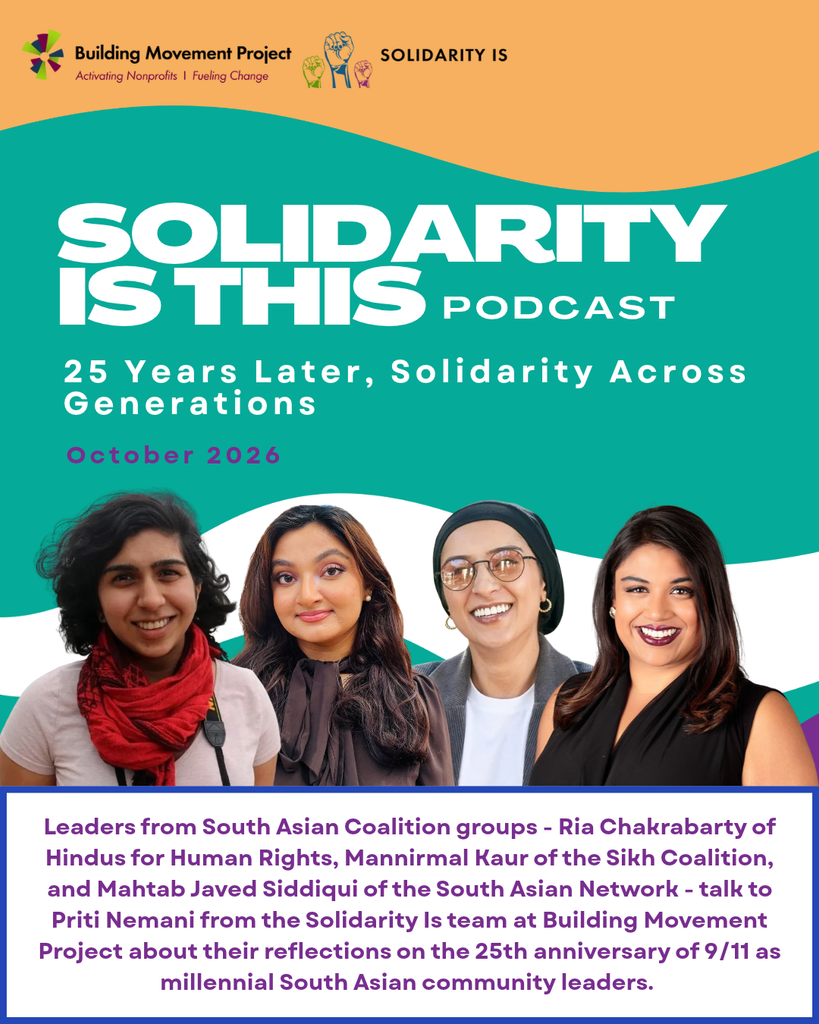
4. Multiple generations are reckoning with 9/11 and the backlash, each in their own way. At this moment, several generations are coming to terms with 9/11 in their own distinct ways. While some were on the front lines on and after 9/11, others were not even born yet and would come to their understanding of 9/11 through community stories and history lessons. Others who were children and teens are piecing together what happened, asking history to fill in the gaps where memories are blurred. Each generation has its own gaps in history and in memory to address, and that requires different approaches to learning and understanding. Listen to the October 2026 Solidarity is This podcast episode from Building Movement Project where leaders from SAC member groups – Hindus for Human Rights, Sikh Coalition, and South Asian Network – share their intergenerational perspectives on the 25th anniversary. The 25 Years Later Hub also includes testimonials from community leaders from SAC member groups about their experience on 9/11 and what came after.
5. South Asian community organizations have spent the last 25 years engaged in advocacy and organizing on the front lines in the wake of the backlash and the War on Terror. These groups continue to do this work without the necessary infrastructure for long-term sustainability. For example, the Sikh Coalition was born on the night of 9/11, and other groups were ignited in the wake of 9/11, like Alliance of South Asians Taking Action (ASATA) in the Bay Area. Many of these groups, in an unfamiliar and tumultuous landscape, accepted the challenge to lead our communities in defense and power-building in the wake of the attacks on BAMEMSA and SWANA communities after 9/11, and many of these groups continue this work in the current risk-laden climate with limited support. To continue this work for the next 25 years, BAMEMSA and SWANA groups need long-term infrastructure and sustaining investment. For example, Muslims for Just Futures has been leading the call for national divestment from the War on Terror infrastructure and investment into communities of care.
6. Documentation and archival are critical movement building strategies. The 25 Years Later Resource Library and Voices from the Field offerings provide accounts of survival and resilience, solidarity, and movement building. BAMEMSA and SWANA communities would benefit from transitional justice efforts and public fora for truth and accountability in order toto create a historical record and to seek redress for the harms suffered. Additionally, the South Asian American Digital Archive (SAADA) includes a library of resources on the post 9/11 climate, including material gathered from South Asian Americans Leading Together (SAALT), a national organization that responded to the backlash.
7. Solidarity remains our collective path to survival now in the wake of new and reinvigorated targeting of Black and Brown communities. After 9/11, many communities within the BAMEMSA and SWANA ecosystem moved together in solidarity, understanding that differences in faith, race, or ethnicity fell to the wayside in the face of broad targeting by the government and hateful actors. Similar steps of solidarity are present now, as BAMEMSA and SWANA groups work together and alongside groups in the broader immigration justice, civil rights, and LGBTQ+ rights ecosystems. To move toward a future free of hate and state violence, transformative, cross-community solidarity is our path.
Appendix
Deep Dive: Understanding the Landscape of Anti-South Asian Hate
State of South Asian Hate. Several organizations have documented the recent rise in anti-South Asian hate. Reports and commentary Stop AAPI Hate (SAH), the Global Project on Hate and Extremism (GPAHE), the Center for the Study of Organized Hate (CSOH), and Pew Research (Pew) reveal a strong, cyclical relationship between online hate, instances of offline hate, and the general anti-immigrant climate in which we are currently living. Below, please find key figures and takeaways on current trends in anti-South Asian, anti-Muslim, and anti-Sikh hate, as well as list of links to all reports referenced in this Appendix.
Online Hate:
- According to Stop AAPI Hate, 71% of all anti-Asian threats of violence between August 2024 and December 2025 were directed at South Asians. (SAH).
- Between January 2023 and December 2025, use of anti-South Asian slurs rose by 109%. (SAH).
- Between January 2025 – June 2026, CSOH found more than half a million anti-South Asian posts on X. Monthly volume rose 75% during this period and 240% from January 2024 to June 2026. (CSOH).
- GPAHE found that anti-Sikh and anti-South Asian rhetoric on fringe platforms surged, with mentions of slurs growing by 66 percent from September 11 to September 15 of 2026. (GPAHE).
- Some of the online hate is fueled by public figures. CSOH found that between February 2025 and March 2026, 46 GOP elected officials published over 1,100 posts targeting Muslim Americans with bigotry and conspiracy theories.
CSOH has identified 6 key drivers of online hate:
- State Power, Racist policy, and incendiary rhetoric (what our public officials say about us)
- Xenophobic nationalism (MAGA, remigration)
- Racial hostility (anti-South Asian attitudes)
- Political visibility and perceived demographic threat (more political visibility)
- Economic resentment (perception that all South Asians are affluent)
- Digital amplification of hate (AI-generated hate)
Hate Acts
- Half of South Asian adults experienced a race-based hate act: According to SAH, 48% of South Asian adults said they experienced a hate act due to their race, ethnicity, or nationality in 2025. The top locations where South Asian adults experienced hate were online (49%); in public streets, parks, parking lots, or on public transit (40%); and at businesses (34%). Many South Asian adults (61%) were also targeted for other aspects of their identity in addition to their race, ethnicity, or nationality in hate acts. The top additional identities targeted were religion (29%), immigration status (23%), and class (23%).
- Anti-Muslim hate. CAIR received 8,683 complaints nationwide in 2025, making it the highest number of single-year complaints CAIR has recorded since their first civil rights report covering 1996 was published. By some measures, public attitudes toward Islam have become more negative than they were immediately after the 9/11 attacks. In March 2002, just six months after the al-Qaida attacks, 25% of U.S. adults said the Islamic religion is more likely than other religions to encourage violence. In 11 subsequent polls, that figure has never been lower than 38%, and in the past decade it has hovered between 45% and 52%. Early this year, about half of U.S. adults surveyed (51%) said Islam encourages violence more than other religions do (PEW).
- Anti-Sikh Hate: An analysis by the Sikh Coalition and by AAJC | AAJC of FBI hate crime data from 2025 found that hate crimes against Sikhs saw an overall increase of 25% from the prior year. In addition, the Sikh Coalition found that hate crimes against Sikhs peaked in September 2025, the month after the truck accident in Florida.
Anti-Immigrant Climate
- Half of South Asian adults have felt the harms of the current anti-immigrant climate: 55% of South Asian adults said they or another Asian American or Pacific Islander (AA/PI) person in their community have been impacted by the broader social and political climate — particularly changing immigration policies and anti-immigrant sentiment, which affected not only individuals but their families, friends, and broader AA/PI communities. (SAH).
- Arrests, detentions, and deportations of South Asian citizens have increased substantially under Trump: Among Asian regional groups, South Asians have the highest number of ICE arrests, detentions, and deportations under the second Trump administration. Compared with the previous administration, ICE actions involving South Asian citizens rose sharply, with deportations approximately 14 times higher. (SAH).
Historically, the spikes in online hate coincide with the political climate and politics of the day. Stop AAPI Hate identified 4 major spikes in South Asian hate (SAH):
- August 2024: Kamala Harris and Usha Vance entered the election spotlight.
- December 2024 – January 2025: Trump was re-elected.
- May – June 2025: Zohran Mamdani gained national attention during New York City’s mayoral race, and conflict between India and Pakistan escalated.
- August – September 2025: A fatal collision involving a Sikh truck driver received national attention, and the Trump administration instituted a $100,000 H-1B visa fee.
To learn more, read the reports:
- Stop AAPI Hate: The State of South Asian Hate (Sept. 2026)
- Global Project on Hate and Extremism: Hate Against Sikhs and South Asians is Surging Online. The Trump Administration isn’t Helping (Sept. 2026)
- Center for the Study of Organized Hate: The Rising Tide of Anti-South Asian Hate in the United States (Sept. 2026)
- Center for the Study of Organized Hate: Manufacturing the Muslim Threat (April 2026)
- Center for the Study of Organized Hate: The US-Israel War on Iran and the Rise in Hate Against Muslim Americans (March 2026)
- Pew: 25 Years After 9/11, A Portrait of Muslim Americans
- CAIR: 2026 Civil Rights Report – The Right to be Different (January 2026)
- Rutgers Law School Center for Security, Race, and Rights: Punished for Participating: Islamophobia in U.S. Electoral Politics (Oct. 2026)
- The Bridge Initiative: 25 Years of the War on Terror: How Islamophobia Became Policy (Sept. 2026)
- NYTimes: South Asians Face Surging Racism in America (Gift Link)
- NYTimes: After 9/11, Islamophobia Shaped a Generation of Muslim New Yorkers (Gift Link)